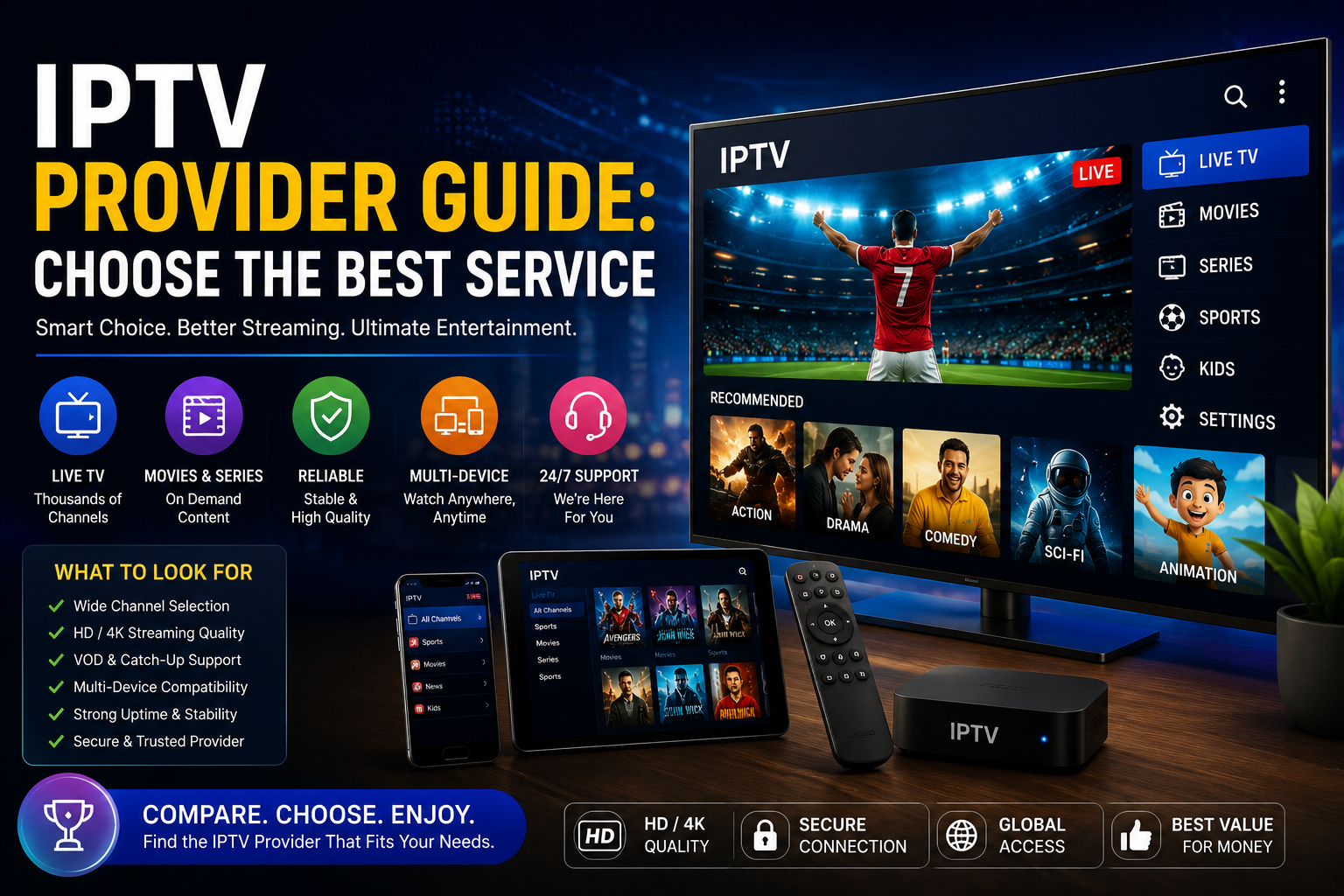
IPTV Provider Guide: Choose the Best Service
IPTV gives you a flexible way to watch live channels, on-demand shows, movies, sports, and international programming over an internet connection instead of cable or satellite. Choosing the right IPTV provider comes down to reliability, content fit, device fit, support, and whether the service is legal and clear. This guide shows what to check before you subscribe IPTV, so you can compare options with confidence and avoid a poor viewing experience.\n\n## How do you get IPTV?\n\nYou get IPTV by choosing an IPTV streaming service, making an account or subscription, installing the provider’s app or a supported player on your device, and using a stable internet connection. In many cases, setup is simple: sign up, get login details, download the app, and start watching. The real choice is not whether IPTV is easy to access. It is which service is dependable, legal, easy to use, and fit for your home.\n\nAt its core, IPTV means internet protocol television. Instead of cable lines or a satellite dish, your content streams over the internet. That means your experience depends on both the IPTV provider and your own connection, including speed, stability, router quality, and how many people use the network at once.\n\nThere are different types of IPTV services. Some are large legal streaming platforms that offer live TV bundles. Others focus on niche channels, international programming, or on-demand libraries. The phrase best IPTV streaming service can mean different things depending on the viewer. For one person, the best streaming TV service is the one with sports and local channels. For another, it is the option with multilingual content, a smooth app, and a fair monthly price.\n\nBefore you sign up, make sure you understand exactly what is included, how billing works, what devices are supported, and whether the IPTV provider clearly explains its service. A trustworthy provider should not make vague promises, hide basic information, or pressure you into a long subscription before you have tested the experience.\n\n \n\n## The right IPTV provider starts with your viewing habits\n\nA good choice starts with one simple question: what do you actually watch? Many people search for top rated IPTV or the best IPTV, then get overwhelmed by similar-looking offers. A better approach is to list your needs first, then judge each service against those priorities.\n\nIf you mainly watch live sports, your needs are different from someone who wants movies, kids’ shows, international news, or local channels. Sports viewers often care about smooth live playback, low buffering, event access, and channel stability. Families may care more about parental controls, multiple profiles, simple menus, and solid viewing on several devices.\n\nThink about a normal week. Do you watch live TV every day, or mostly stream on demand? Do you need channels from the United States, Latin America, Europe, South Asia, the Middle East, or another region? Are you replacing cable, or adding an IPTV service for content your current platforms do not offer?\n\nA practical checklist can help narrow the field:\n\n* Must-have content: live channels, movies, series, sports, news, local stations, or international programming.\n* Preferred devices: smart TV, streaming stick, phone, tablet, laptop, or TV box.\n* Household size: one viewer, couple, family, roommates, or multi-room use.\n* Budget comfort: monthly flexibility versus longer subscription savings.\n* Technical comfort: plug-and-play app versus manual playlist or player setup.\n* Support needs: live chat, email support, setup guides, or quick troubleshooting.\n\nOnce you know these answers, IPTV best becomes less about hype and more about fit. A service with thousands of channels may sound impressive, but if it lacks the few channels you watch daily, it is not the best choice for you. Likewise, a smaller, clean service with steady streams and quick support may give a better result than a larger but poor one.\n\n## What makes the best IPTV streaming service worth choosing?\n\nThe best IPTV streaming service is the one that gives you the content you want, on the devices you use, with little buffering, clear pricing, and solid support. It should feel easy to move through, steady at peak times, and clear enough that you know what you pay for. A low price helps, but it should never be the only reason you choose an IPTV provider.\n\nReliability is often the first thing viewers notice. A service may look good during setup, but if channels freeze during major events or the app crashes again and again, the value fades fast. Look for signs that the IPTV provider takes performance seriously, such as clear device steps, trial options, realistic claims, and support that answers common technical questions.\n\nContent quality also matters. More channels do not always mean a better result. Some providers advertise huge libraries, but the real use depends on order, working links, stream quality, and how often content is updated. A well-made service should make it easy to find what you want without endless broken or irrelevant listings.\n\nThe best streaming TV service for your home should also be easy enough for everyone to use. If only one tech-savvy person can run it, stress builds fast. Menus should be clear, search should work well, and switching between live TV and on-demand content should feel smooth.\n\nWhen comparing providers, pay attention to:\n\n1. Stream stability \n The service should perform well during evenings, weekends, and popular live events, not just during quiet hours.\n\n2. Picture quality options \n HD and higher-quality streams are valuable, but only if they play smoothly on your connection.\n\n3. Channel relevance \n A smaller selection of channels you actually use is better than a massive list full of filler.\n\n4. Device support \n Confirm fit with your smart TV, Android device, Fire TV, Apple device, browser, or IPTV player before paying.\n\n5. Support quality \n Good support should help with setup, login issues, app guidance, and basic troubleshooting.\n\n6. Transparent subscription terms \n Before you subscribe IPTV, understand renewal terms, refund conditions, trial rules, and cancellation options.\n\nA provider that performs well across these areas is usually more valuable than one that simply claims to be top rated IPTV. Marketing language is easy to write. Steady playback, clear communication, and useful support are harder to fake.\n\n## Legal and safe access should be a priority\n\nAny conversation about IPTV should include legality and safety. IPTV technology itself is not illegal. Many legitimate services use internet delivery to provide live television and on-demand content. The concern comes from providers that may offer copyrighted channels, movies, or sports without proper rights or clear licensing.\n\nAs a viewer, you do not need to become a media law expert, but you should use common sense. If a provider promises every premium channel, every pay-per-view event, every movie release, and every sports package for a very low price, that is a warning sign. If the website gives no company information, no support details, no terms, and no clear explanation of what is being sold, be cautious.\n\nChoosing a questionable IPTV provider can create several problems. Streams may disappear suddenly, payment information may be poorly protected, support may vanish, and the service may stop working without notice. Even if the low price feels attractive, the risk can outweigh the savings.\n\nLook for safer signs such as:\n\n* Clear service descriptions and subscription terms.\n* Professional setup instructions and support channels.\n* Payment steps that feel safe and familiar.\n* Realistic content claims rather than everything-included promises.\n* A trial or short-term plan before a longer commitment.\n* A privacy policy, refund policy, or terms of service.\n\nThis is especially important when searching broad phrases like america IPTV, best IPTV, or IPTV provider. Search results can include a mix of legal platforms, resellers, review pages, and unclear offers. Take your time, compare carefully, and avoid any service that feels evasive about what it provides.\n\n## Device compatibility shapes the daily experience\n\nA service can have strong content and still be frustrating if it does not work well on your preferred devices. Before subscribing, check whether the IPTV provider supports your exact setup. Many viewers use smart TVs, Fire TV devices, Android TV boxes, Apple TV, tablets, smartphones, or laptops. Some services have their own apps, while others require a third-party IPTV player.\n\nIf you want the simplest experience, look for a provider with clear installation guides for your device. The fewer steps required, the easier it will be for everyone in the home to use. If you are comfortable with technology, manual setup may not bother you, but it should still be documented clearly.\n\nPerformance can vary by device. A newer streaming device with enough memory and strong Wi-Fi may handle IPTV better than an older smart TV with limited app support. If buffering is a recurring issue, the problem may be the provider, your internet connection, your router, or the device itself. That is why testing before committing to a long plan is so useful.\n\nA practical device-readiness check includes:\n\n* Confirm the service works on your main viewing screen.\n* Ask whether multiple devices can be used at the same time.\n* Check if the provider limits connections per account.\n* Make sure the app or player is easy to update.\n* Test both live channels and on-demand content.\n* Try the service during the times you normally watch TV.\n\nIf the provider offers a trial, use it like a real viewer. Watch sports if sports matter. Test kids’ content if the family will use it. Open the app on the device you plan to use most. A trial is not just about seeing whether the service loads. It is about seeing whether it fits your normal routine.\n\n## Pricing, trials, and subscriptions need careful attention\n\nPrice matters, but value matters more. The cheapest IPTV streaming service may become expensive if it buffers constantly, lacks support, or misses the channels you expected. On the other hand, the most expensive option is not automatically the best IPTV streaming service either. The right choice balances content, reliability, convenience, and trust.\n\nMany providers offer monthly, quarterly, 6-month, or annual plans. Longer plans may seem cheaper per month, but they also raise your risk if the service quality changes or does not meet expectations. If you are trying a provider for the first time, a short plan is usually safer.\n\nBefore you subscribe IPTV, review the details carefully:\n\n* Trial availability: Can you test the service before committing?\n* Plan length: Are you paying monthly or locking in for longer?\n* Connection limits: How many devices can stream at once?\n* Renewal process: Does the subscription renew automatically?\n* Refund policy: Is there a clear process if the service does not work?\n* Support access: Can you reach someone if setup fails?\n\nBe wary of pressure tactics. A provider that pushes you to buy a long-term plan immediately may not be confident in its own service. A trustworthy provider should be comfortable letting you test performance, ask questions, and make a practical decision.\n\nPricing should also be judged against what you are replacing. If IPTV is replacing cable, consider the mix of services you may still need, including internet, streaming apps, sports subscriptions, or premium channels. The best streaming TV service is not always one provider. For many homes, the ideal setup is a mix of services that covers needs without extra overlap.\n\n## Is America IPTV different from other viewing needs?\n\nAmerica IPTV usually refers to IPTV options focused on viewers in the United States or people who want American channels, sports, news, entertainment, and local-style programming. The main difference is content priority: U.S. viewers may care about local channels, national networks, regional sports, English-language programming, and fit with common devices used in American homes. International viewers looking for American content may also care about time zones, channel availability, and smooth access from their location.\n\nIf you are in the United States, your internet connection quality, home network, and device setup will strongly shape your experience. Many homes use Wi-Fi across multiple rooms, with phones, laptops, game consoles, smart TVs, and security devices all sharing bandwidth. IPTV can work well in that setup, but it benefits from a stable connection and a strong router.\n\nFor viewers who want America IPTV as part of a broader international setup, content mix becomes more important. You may want American news and entertainment alongside channels from another country or language group. In that case, choose an IPTV provider that organizes content clearly by region and category. A cluttered channel list can make international viewing feel harder than it should.\n\nU.S.-focused viewers should also think about local programming. Not every IPTV provider includes local channels, and availability can vary widely. If local news, weather, or regional sports matter to you, verify those details before you pay. Do not assume a service includes specific channels simply because it uses broad phrases like USA channels or complete package.\n\n## Performance depends on more than internet speed\n\nA fast internet plan helps, but speed alone does not guarantee smooth IPTV. Stability, lag, Wi-Fi coverage, router placement, device quality, and provider infrastructure all affect playback. This is why two homes with similar internet plans can have very different streaming experiences.\n\nStart with your home network. If your TV is far from the router, Wi-Fi signal may be weak even if your internet plan is strong. Walls, distance, interference, and older routers can all cause buffering. If possible, use a wired Ethernet connection for your main streaming device, especially if you watch live sports or high-definition content.\n\nAlso consider how many people are online at once. IPTV may struggle if someone is gaming, another person is on a video call, and several devices are streaming in the background. A good router can manage traffic better, but no IPTV provider can fully overcome an unstable home network.\n\nHere are practical ways to improve IPTV performance:\n\n* Place your router in a central, open location.\n* Restart your router and streaming device if playback becomes unstable.\n* Use Ethernet for your main TV when possible.\n* Close unused apps on streaming devices.\n* Keep your IPTV app or player updated.\n* Test playback at different times of day.\n* Contact support with specific details, such as device type and issue timing.\n\nA reliable provider should help you troubleshoot without blaming every issue on your internet. At the same time, viewers should be realistic: IPTV is a streaming experience, so your home setup matters.\n\n
 \n\n## Reviews and ratings are useful, but they need context\n\nSearching for top rated IPTV can help, but ratings should not be your only decision tool. Some reviews are thoughtful and detailed, while others may be promotional, old, or based on a very different viewing need. A five-star review from someone who watches international movies may not help you if you need live sports and local channels.\n\nLook for reviews that mention specific details. Useful feedback often covers setup, buffering, channel reliability, support response, device performance, and billing. Vague comments like best IPTV ever or works great are less helpful because they do not explain the conditions behind the experience.\n\nPay attention to patterns rather than single opinions. If many users mention poor support, frequent downtime, or confusing billing, take that seriously. If many users praise stability, clear setup, and responsive help, that is encouraging. Still, your own trial is the best test because IPTV performance can depend on your location, device, and network.\n\nIt also helps to compare provider claims with user experiences. If a provider advertises premium quality but reviews mention broken channels or inconsistent playback, proceed carefully. If a provider makes modest claims and consistently delivers on them, that may be a better sign of long-term reliability.\n\n## A simple process for choosing confidently\n\nThe easiest way to avoid regret is to follow a step-by-step process. Instead of jumping on the first service that says the best IPTV, slow down and compare a few options with the same criteria. This turns a confusing search into a practical decision.\n\nUse this process before you subscribe:\n\n1. List your must-have channels and content types \n Include live TV, sports, movies, shows, local channels, international content, and language preferences.\n\n2. Choose your main viewing devices \n Decide whether you will watch on a smart TV, streaming stick, phone, tablet, laptop, or TV box.\n\n3. Shortlist providers that match your needs \n Ignore services that do not clearly support your devices or content priorities.\n\n4. Check if it is real and clear \n Review service details, terms, support options, and payment process before sharing information.\n\n5. Test with a trial or short plan \n Use the service during normal viewing hours and test the content that matters most.\n\n6. Evaluate support before committing longer \n Ask a setup or account question and see whether the IPTV provider responds clearly.\n\n7. Only then consider a longer subscription \n If the service performs well and fits your home, you can decide whether a longer plan makes sense.\n\nThis process may take a little more time upfront, but it can save frustration later. IPTV is not just a product you buy once. It is a service you rely on whenever you sit down to watch. A careful choice leads to a smoother daily experience.\n\n## Common mistakes to avoid when selecting IPTV\n\nMany IPTV problems start before the first stream ever plays. Viewers often choose too fast, focus only on price, or assume every provider offers the same experience. Avoiding a few common mistakes can help you find the best IPTV streaming service for your needs.\n\nOne mistake is buying the longest plan right away. Even if the discount looks appealing, you have not yet confirmed quality, support, or content accuracy. Start smaller, test properly, and upgrade later if the provider earns your trust.\n\nAnother mistake is ignoring device fit. A service may work well on one platform and poorly on another. If you plan to watch on a specific smart TV or streaming device, confirm support before subscribing.\n\nA third mistake is chasing the biggest channel count. Large numbers sound impressive, but working channels, clean organization, and content relevance are more important. You are not paying to scroll. You are paying to watch.\n\nAlso avoid assuming that every review is independent. Some websites promote services through affiliate relationships or paid placements. That does not automatically make the information useless, but it means you should look for detailed reasoning and compare multiple sources of feedback.\n\nMost importantly, do not overlook safety. Protect your payment information, use strong passwords, and be careful with any provider that asks for odd payment methods or avoids basic business transparency.\n\n## The best IPTV choice is the one that fits your life\n\nThere is no single IPTV provider that is perfect for every viewer. The best IPTV for you depends on what you watch, where you live, which devices you use, how much support you need, and how comfortable you are with setup. A service that is excellent for a sports fan may be unnecessary for someone who mainly wants movies. A platform that works well for one home may be too technical or too limited for another.\n\nThe smartest approach is practical and patient. Define your must-haves, compare services carefully, test before committing, and choose the provider that delivers steady value instead of the loudest marketing claims. Whether you are looking for america IPTV options, a full IPTV streaming service, or the best streaming TV service to replace cable, focus on reliability, transparency, and everyday use.\n\nIf you remember one thing, make it this: the best choice is not always the provider with the most channels or the lowest price. It is the one that lets you sit down, find what you want, and watch without constant frustration. That is what turns IPTV from another subscription into a service that truly improves your entertainment experience.\n\n## Q&A\n\nQuestion: What should I check before I subscribe IPTV for the first time?\n\nShort answer: Start by confirming that the provider offers the channels, sports, movies, local programming, or international content you actually watch. Then check device fit, connection limits, subscription terms, refund rules, support options, and whether a trial or short-term plan is available. It is safer to test performance during your normal viewing hours before committing to a longer subscription.\n\nQuestion: Is IPTV legal to use?\n\nShort answer: IPTV technology itself is not illegal, and many legitimate streaming services use internet delivery for live TV and on-demand content. The risk comes from providers that may offer copyrighted channels, movies, or sports without proper rights. Be cautious of services that promise everything included for a very low price, hide company details, or fail to provide clear terms, support, and payment information.\n\nQuestion: Why does IPTV buffer even if I have fast internet?\n\nShort answer: Internet speed is only one part of IPTV performance. Buffering can also come from weak Wi-Fi, router placement, an overloaded home network, an older streaming device, app issues, or the IPTV provider’s own infrastructure. Using Ethernet when possible, updating apps, restarting devices, testing at different times, and contacting support with specific device details can help identify the cause.\n\nQuestion: Are more channels always better when choosing an IPTV provider?\n\nShort answer: No. A large channel count can sound appealing, but it does not guarantee a better experience. Working streams, steady playback, clear organization, relevant content, and responsive support matter more than a massive list full of channels you do not use. The best IPTV service is the one that consistently delivers the content your home actually watches.\n\nQuestion: How should I use an IPTV trial effectively?\n\nShort answer: Treat the trial like real viewing, not just a quick setup test. Watch the channels, sports, movies, kids’ content, or international programming that matter most to you. Test the service on your main device, during the times you normally watch, and check both live TV and on-demand content. This gives you a better sense of whether the service fits your routine before you pay for a longer plan.